

Above: Jevgenij Raskatov, professor of chemistry and biochemistry: “Great challenges bring with them great opportunities for human growth.” (Photo by Carolyn Lagattuta)
At the age of 13, young Zhenya was beginning a dramatic new chapter in life. Entering his teen years, Zhenya had just been uprooted from his city of birth, Moscow, leaving behind the collapse of the Soviet Union and the breakdown of law and order in the 1990s. The family resettled in the unfamiliar setting of Sandhausen, a small town just south of Heidelberg, Germany. Both of his parents were Russian-Jewish classical-music composers, raising their son to be a professional cellist.
Then suddenly, devastation. His 40-year-old mother suffered a near-fatal stroke that destroyed a quarter of her brain. The music lessons stopped, and Zhenya sunk into deep despair, worsened by the social isolation faced by Jewish immigrants at the time, gang violence, poverty, and, worst of all, an environment characterized by a total lack of hope for a better future.
In a foreign country, the family had no knowledge of how to access medical services; health-care costs plunged them into poverty. And despite Germany’s relatively strong economy, moving there didn’t automatically improve their lives; they were still surrounded by people with similar problems and little optimism. Things went from bad to worse.
Today, at UC Santa Cruz, Zhenya is known as Jevgenij Raskatov, a professor of chemistry and biochemistry, and head of a research group focused on molecular-level discoveries that aim to help drug makers produce better treatments for Alzheimer’s disease. Raskatov’s long journey to this point was driven by his need to understand the world with precision, by the wisdom of his peers, and by a trait all good scientists must have: the courage to question convention.
From his home on campus, Raskatov reflects on those dark days of his youth, but not so much with sadness. He retains an undercurrent of boyish wonder, along with an ear for melody.
“I could no longer continue music. I was extremely depressed for a few years,” he said with a whimsical flow that infuses his voice. “Great challenges bring with them great opportunities for human growth.”
Catalyst for learning
In Heidelberg, Raskatov met a teacher named Helmut Stahl, who saw potential in the troubled boy and introduced him to complex chemistry material after school. Zhenya dove in with the same intellectual hunger that allowed him to memorize every type of tree and mushroom in the Russian forests as a child.
“Chemistry was a very good refuge for me because it was something I enjoyed, it was something that was abstract,” Raskatov recalls. “So it removed me from my daily suffering. It removed me from my problematic environment.”
The next educator to guide Raskatov on the academic path was his neighbor Dietmar Ziegler, who worked at Heidelberg University and would take the teenage boy onto campus to expose him to a more tranquil and intellectual environment.
“Wow, it’s actually OK to think here,” Raskatov remembers saying at the time. “From that moment on, at about the age of 16, I knew immediately that I wanted to be a professor.”
By the time he entered Heidelberg University as a student, Raskatov said he had learned so much chemistry that he could bypass a whole year of lectures. Along with chemistry, he remained interested in biology. But when he compared the two fields, he felt biology lacked the molecular-level precision he preferred when seeking to understand the natural world. So his undergraduate studies focused on organic chemistry and quantum chemical calculations.
He excelled, and one of his favorite professors, Guenter Helmchen, complimented Raskatov that he was doing well with calculations and helped him understand the problems that experimentalists were presenting. But the professor also challenged the prodigy: “He said it would be infinitely better if I could study problems that are my own,” Raskatov said. “And so, he encouraged me very strongly to become an experimentalist and sent me to Oxford, which is where I later did my Ph.D.”
A big breakthrough
At Oxford, Raskatov studied organometallic catalysis and transition-metal catalysis. It was a major departure from the field of chemistry he had studied up to that point. But the academic excursion exposed him to an entirely new area of research that would come into play later in his career.
He paused here to stress the importance of this.
“This doesn’t happen nearly enough in academia today,” he said. “People don’t change fields. They get stuck and continue adding decorative trim to what they started with as Ph.D. students. But the big breakthroughs stop.”
So what was his big breakthrough? In short, his research group’s confirmation in 2022 of the “rippled beta sheet”—an unusual structural motif first theorized to exist in the proteins of living cells over 70 years ago by the Nobel-winning chemist Linus Pauling and his collaborator Robert Corey. They, along with physicist and chemist Herman Branson, discovered the alpha-helix and the pleated beta sheet—now known to form the backbones of tens of thousands of proteins.

This illustration shows the “left-handed” and “right-handed” triphenylalanine peptides that bond together to form a rippled beta sheet. (Illustration by Jevgenij Raskatov)
Proteins consist of long chains of amino acids folded into complex three-dimensional shapes that enable them to carry out a wide array of functions in all living things. A pleated beta sheet is composed of linear strands (called beta strands) bonded together side by side to form a two-dimensional sheetlike structure. A rippled beta sheet is similar except that alternate strands are mirror images of each other.
Until Raskatov’s team confirmed the creation of a rippled beta sheet in the lab using x-ray crystallography—the gold standard for determining protein structures—it languished in obscurity as a rarely studied and largely theoretical structure, according to Harry Gray, a longtime chemistry professor at the California Institute of Technology who was a colleague of Pauling. Among Gray’s many awards and honors are the National Medal of Science (1986), seven national awards from the American Chemical Society, and 22 honorary doctorates.
“These rippled-sheet structures that Pauling and Corey predicted over 70 years ago have been sitting around, and no one’s really been able to make them until Jevgenij figured out how to make them systematically,” Gray said. “I would definitely call it a breakthrough in the protein-structure field.”
Raskatov has also collaborated with some of the nation’s leading chemists to bolster his rippled-sheet research, including David Eisenberg, a professor at UCLA who has published over 300 papers and reviews, and holds half-a-dozen patents. Another close collaborator is the theoretical chemist William Goddard III, a professor at Caltech regarded as a pioneer in developing methods for quantum mechanics, force fields, molecular dynamics, and many other areas.
Ripple effects
But why try to prove the existence of something so esoteric? First, some scientists believe the rippled-sheet structure could be used in synthetic materials to make them more durable or effective. An example would be hydrogels, which have biomedical applications such as the timed release of drugs to reduce side effects.

The dimeric rippled sheets assembled into a layered crystal structure with a herringbone pattern. (Image credit: Kuhn et al., Chemical Science 2021)
One study, which Raskatov wasn’t involved with, suggests that hydrogels made of rippled-sheet proteins would be stronger than products currently on the market and break down more slowly. And so, with the ability to absorb and hold large amounts of water, such next-generation hydrogels could do a better job in agriculture (irrigation in dry climates), personal hygiene (more absorbent diapers and sanitary pads), and consumer products like cooling pads and moisturizing lotions.
The second reason Raskatov has devoted so much of his time and energy to better understanding the rippled beta sheet is because of the encouragement of—and occasional warnings from—formative figures he crossed paths with over the years. After earning his doctorate in organic chemistry from Oxford, he turned back toward the life sciences and studied the chemical biology of cancer at Caltech as a Humboldt Research Fellow.
There, he spoke to the renowned chemist David Milstein, who was visiting from the Weizmann Institute of Science in Israel. During his visit, Milstein told Raskatov that the different branches of chemistry he studied meant that he had “a fingerprint that nobody else has.” So, Milstein’s advice was for Raskatov to find a question or problem that’s different from anything he’s previously studied. That way, Milstein said, all the findings would be new and interesting.
“More people should be given advice like this. But that doesn’t really seem to happen these days. Everybody’s very conservative,” Raskatov said.
Fortunately, the head of the lab Raskatov was in, Caltech Chemistry Professor Peter Dervan, also wanted him to figure out what he wanted to research going forward. So Dervan generously offered him three months off to go and “invent his field.” That’s when Raskatov, who remained very interested in brain health due to his mother’s stroke, started thinking about neuroscience and amyloids.
Gradually, he focused on amyloid beta—the proteins thought to lead to Alzheimer’s disease when they accumulate in the brain. Then, because of his knowledge of organometallics, he conducted a research experiment using a mirror image of amyloid beta to promote an oligomer-to-fibril conversion to reduce the protein’s toxicity. The technique, which he called “chiral inactivation,” was published in the prestigious German journal Angewandte Chemie (Applied Chemistry) and recognized as a particularly important contribution.
Pioneering contributions
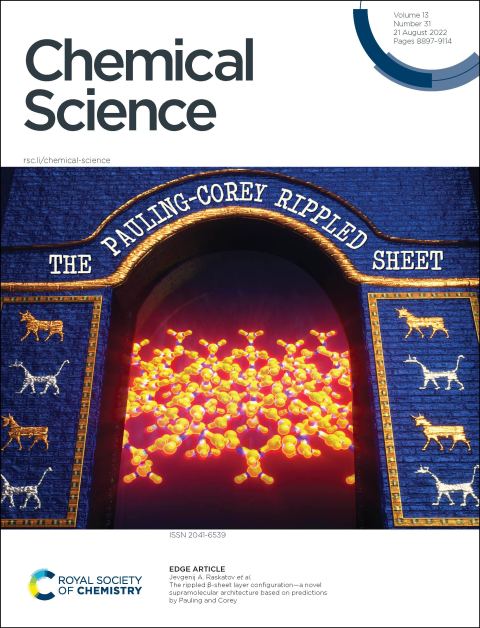
Chemical Science magazine featuring the rippled β-sheet layer configuration—a novel supramolecular architecture based on predictions by Pauling and Corey on the cover.
After that, Raskatov said he was offered many opportunities to speak about the discovery at seminars and conferences in the United States and internationally. And when he “carefully invoked” the rippled beta sheet as the mechanistic, underlying rationale, Raskatov said he got a lot of pushback—including from friends and mentors who cautioned him that he didn’t yet have the academic tenure to hang research on something still so theoretical.
“In my very first research proposal to the National Institutes of Health, they literally called it heretical,” Raskatov said.
Raskatov joined the Chemistry & Biochemistry Department’s faculty after finishing his research fellowship at Caltech in 2014. In 2022, he received the first grant from The Seaver Institute, a philanthropic organization, to begin exploring rippled sheets. Thanks to their support at a critical time, today, his lab carries out second-to-none research in an area of inquiry that had been completely new to him before he came to UC Santa Cruz.
Indeed, the area of rippled sheets barely existed at all. The lab is now designing novel approaches to block toxicity of amyloid beta that can help drug makers develop more effective treatments for Alzheimer’s, and also devising supramolecular rippled-sheet polymers as a new class of materials with unique properties. And in March, he chaired the first symposium on the rippled beta sheet at the American Chemical Society’s spring conference in New Orleans.
“Jevgenij has done brilliant work in the study of factors that underlie Alzheimer’s disease. At the start of his independent career, with no experience in this very competitive area, he initiated a very creative and impactful program,” said Samuel Gellman, a leading peptide chemist and professor at the University of Wisconsin–Madison. “In the course of this work, he developed an interest in a very fundamental aspect of the chemistry of proteins—the rippled sheets. He has made pioneering contributions in this area.”
Could more fundamentals await discovery?
Beyond the possibility of creating next-generation hydrogels that would improve drug-delivery systems and other biomedical applications, Raskatov remains excited about the rippled beta sheet for a more fundamental reason that speaks to his nature as an educator. To him, its evolution from a theoretical to proven concept puts the rippled sheet’s confirmation on par with the discovery of the structure of DNA, or even what’s inside a nucleus.
Some scientists believe that the pattern over the last century or so has been the gradual discovery of such foundational concepts, one after another, resulting in fewer discoveries for the next generation of researchers to make—ultimately leading to a general sense of fatigue and frustration across the field.
“I’m very happy and extremely lucky that, I think, the rippled sheet is an extraordinary exception to that rule. It shows that there may be more fundamentals to be discovered,” Raskatov said. “If you can do something that solves an unmet need, that’s fantastic. We always think about that. But we should also not forget what academia is actually about, and that is education. We are training people how to think. I always tell my students: Learn how to think, and not what to think.”